Playboook.
A reference specimen of one endorsed UK Global Talent Visa application — Exceptional Talent, Architecture route — with the source applicant's notes alongside.
The complete submitted pack — CV, evidence, personal statement, recommendation letters, and submission notes — reproduced as it was submitted, redacted only for identity, and accompanied by margin notes documenting the reasoning behind each document's role in the application. Provided as a reference specimen of one case. Not legal or immigration advice.
Inside the Playboook
/05First sort to Stage 1 decision
Strategy → Submission, each tied to one job
1 CV · 3 letters · 10 evidence pieces · 39 pages
Five modules with margin notes alongside every document — Strategy, Portfolio, CV, Recommendation Letters, Submission. Lifetime updates as the notes continue to expand, plus a direct line for clarification during the launch window.
What this is
Playboook is a paid reference specimen documenting one endorsed UK Global Talent Visa application — Exceptional Talent tier, Architecture route, endorsed in January 2026 by RIBA under Arts Council England. The full 29-page Stage 1 pack is reproduced as it was submitted, with identity details redacted, and accompanied by margin notes that document the reasoning behind each document's structure and inclusion. The pack describes one case and does not constitute legal or immigration advice.
Who it's for
Who this is for
- Applicants with substantive work but no clear presentation structure
The bottleneck on most Global Talent applications is framing, not effort. The pack documents one case's choices — what was kept, what was cut, and the order the documents were arranged in.
- Applicants on the Architecture route or other Arts Council England routes
The source application was endorsed by RIBA under ACE on the Architecture route. Visual Arts, Combined Arts, and other ACE-endorsed routes use the same assessor reading rhythm; the evidence shape inside the pack is route-specific.
- Applicants self-assessing between Exceptional Talent and Exceptional Promise
The pack documents a Talent-tier case in detail and can be used as a structural reference for self-comparison. The pack does not advise on which tier any other applicant should pursue.
- Applicants looking for a structural reference rather than a coach
Each document in the pack is accompanied by margin notes from the source applicant describing its role inside the application. The pack does not provide one-to-one advice or feedback on any reader's application.
Who this isn't for
- Readers looking for copy-paste templates
Originality forms part of the assessment, and recycled wording is one of the more visible patterns the Home Office flags. The pack contains reasoning and structure rather than reusable phrasing.
- Readers looking to reuse the source documents directly
The pack is sanitised on purpose. It provides structure, sequence, and notes alongside the documents; it does not provide original files, identities, or wording for reuse.
- Readers looking for regulated immigration advice
Eligibility checks, complex personal history, refusal recovery, and status risk are outside the scope of this pack. Those are handled by OISC-regulated advisers or solicitors, not by self-guided reference material.
- Readers looking for an endorsement guarantee
The pack documents one endorsed application. Outcomes depend on the reader's own evidence, the assessor on the day, and the published guidance in force at the time of submission. No reference specimen can predict any other application's outcome.
What you get
Five modules, each tied to one job the source application had to do: decide the route, prove the claim with evidence, compress the CV and statement, brief the right referees, and submit a clean pack. Each module reproduces the relevant documents from the pack and the notes describing the reasoning behind their inclusion.
Strategy
Route fit, tier decision, central claim
The strategy module documents the four upstream decisions visible in the source application: which Global Talent route (the case landed on ACE / Architecture, not Visual Arts or Tech Nation), which tier (Exceptional Talent rather than Exceptional Promise), the single-sentence claim the rest of the pack defends, and the 12-week working timeline used during the preparation period.
Evidence preview
The value of the pack is the material itself with notes alongside: every document is reproduced as submitted, redacted only for identity, and accompanied by margin notes describing what it was intended to prove and how it sat inside the rest of the application. The inventory below lists all 14 documents — 39 pages in total — visible before purchase.
Evidence specimens · with notes alongside
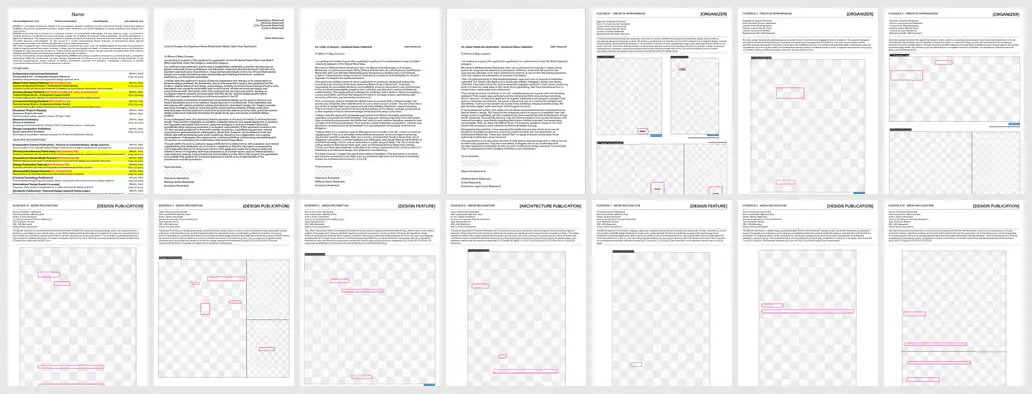 14 specimens · see full version
Low-resolution composite. Open the Portfolio chapter for the full viewers — every page, every redaction, every note alongside.
Pricing
One price: £99 for the full bundle, as a one-off purchase with lifetime updates. The £49 founding window ran for the first 7 days of launch and has closed. Discount codes issued directly by Playboook are the only exception to the standing price.
What you'd pay elsewhere — and what the Playboook costs.
The Playboook sits at the value end of the market. Lower than a strategy call, far lower than full support services — and an Architecture-route reference built from a real endorsed pack.
£99 is the standing price. All five modules are live, margin notes continue to be added and refined across the pack, and every purchase includes lifetime updates. The £49 founding window was a one-off launch incentive and closed at the end of launch week.
- Full reference pack — 14 documents, 39 pages, all five modules
- Lifetime updates as notes are added and refined
- Architecture-route reference specimen of one endorsed case
No refund after purchase. See full terms
The £99 price stands for everyone — codes are the only exception. If you hold one from a promotion, an event, or the maintainer, apply it here and the total carries through to checkout.
- Applies instantly — the price updates before you pay
- One code per purchase, no stacking
- No code? Three qualified referrals earn a free 30-minute consultation
Referral links earn credit, not discounts. How referrals work
Questions
Tier, route, evidence shape, and how the pack is structured.
Pricing, discount codes, modules, and updates.
Scope, copying, affiliation, data, and outcome.